For many investors following Islamic principles, a significant question arises. Can one engage with the global currency market while staying true to faith-based values? This concern is vital for a growing community seeking to participate in worldwide finance.
The foreign exchange arena is among the largest financial markets. It offers notable opportunities. Yet, it also presents specific religious considerations that require careful navigation.
This guide offers a thorough examination. It explores the core tenets of Islamic finance and the requirements of Sharia law. Readers will find practical solutions and review expert scholarly opinions on the matter.
The debate around permissibility is considerable. However, practical pathways exist for ethical participation. This resource aims to provide clear, authoritative information. It helps individuals in the United Kingdom and beyond make informed, faith-compliant decisions about their financial activities.
Understanding Islamic Finance and Sharia Principles in Forex Trading
At the heart of Sharia-compliant financial conduct lie several foundational prohibitions designed to ensure fairness. These rules form a complete ethical system for monetary activities.
Core Principles: Riba, Gharar, and Maisir
The first key rule forbids Riba, or interest. Earning money from money itself, without real economic effort, is not allowed. This affects common fees like overnight charges.
Next is Gharar, meaning excessive uncertainty. Contracts with unclear terms or hidden risks violate this principle. All details must be transparent to both sides.
Finally, Maisir prohibits gambling-like speculation. Activities relying purely on chance, rather than skill and analysis, are considered non-permissible.
Ethical and Transparent Financial Practices
Islamic finance demands full clarity in all agreements. Each party must understand the risks and obligations before any deal is made.
Permissible transactions require actual ownership of assets and prompt settlement. This avoids delay and promotes real economic activity. These principles reflect deeper values of justice and social responsibility in financial life.
What is Forex Trading? Market Fundamentals and Key Concepts

Daily transactions in this sphere exceed $6 trillion, making it the planet’s most liquid financial space. It operates around the clock, five days a week, across global hubs. At its core, this activity involves the simultaneous exchange of one national currency for another.
Basics of Currency Exchange
Currencies are traded in pairs, like EUR/USD. The price movement is measured in pips. Traders deal in standardized lots, and costs are influenced by the spread between buy and sell rates.
Full transparency in these quotes is a fundamental aspect of the market. This clarity allows participants to analyze value shifts effectively.
Comparing Forex with Other Investment Markets
This arena has distinct features when placed beside stocks or bonds.
- High Liquidity: The vast size allows for easy entry and exit.
- Accessibility: It is open to individuals with relatively small capital.
- Two-Way Opportunity: One can potentially profit whether a currency’s value rises or falls.
Common approaches range from rapid day trading to longer-term swing strategies based on analysis.
Grasping these mechanics is the essential first step for any informed market participant. This knowledge provides the necessary context for deeper evaluation.
Exploring the Debate: Is Forex Trading Halal or Haram?

The permissibility of currency exchange activities under Islamic law is a topic of significant discussion among contemporary scholars. Islam encourages believers to seek legitimate improvement of their financial circumstances. This provides a foundational argument for participation.
Respected authorities hold divergent views based on how activities are structured. The debate centers on compliance with core prohibitions.
Traditional Interpretations and Modern Practices
Conservative voices, like Mufti Taqi Usmani, express strong reservations. They cite speculative nature and interest components as primary concerns.
Other scholars offer a more nuanced stance. Dr. Monzer Kahf emphasizes the need for immediate exchange to achieve Sharia compliance.
Sheikh Yusuf DeLorenzo suggests it can be permissible. This requires avoiding riba and maintaining full transparency in all transactions.
The key is that permissibility is conditional. It depends entirely on avoiding excessive uncertainty and gambling-like speculation.
Informed participants must therefore evaluate not just whether to engage, but how to do so in an ethically sound manner.
forex trading halal or haram: Key Considerations
Determining permissibility hinges on a detailed examination of several operational factors. Two primary areas demand particular attention for those seeking faith-aligned participation.
Interest (Riba) and Swap Fees
Conventional brokers typically apply charges for holding positions open past the daily close. These are known as swap or rollover fees.
They represent a clear form of interest based on the differential between national rates. Under Sharia law, any payment or receipt of riba is strictly forbidden.
Therefore, standard accounts with overnight interest charges are fundamentally non-compliant. Eliminating these swap fees is a crucial first step.
Risk, Speculation, and Excessive Uncertainty
Islamic finance distinguishes between calculated business risk and pure chance. Informed analysis based on economic fundamentals is acceptable.
However, activity that relies on guesswork crosses into speculation. This resembles gambling, which is prohibited.
The principle of Gharar warns against contracts with excessive uncertainty. All terms must be transparent, and outcomes should not be wildly unpredictable.
High leverage can amplify risk to imprudent levels. It may also involve borrowing with interest, creating another compliance issue.
Evaluating one’s strategy against these criteria is essential for maintaining halal status.
Islamic Trading Accounts: Features of Swap-Free and Sharia-Compliant Forex Accounts
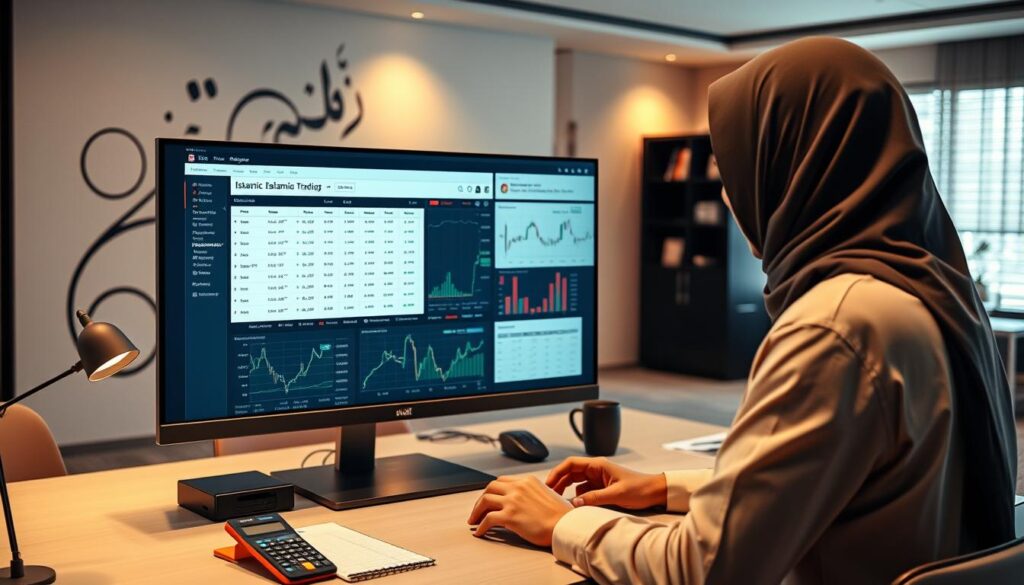
A practical solution for faith-based investors involves using specially designed financial products. These specialized trading accounts are crafted to adhere to religious guidelines.
How Islamic Accounts Work
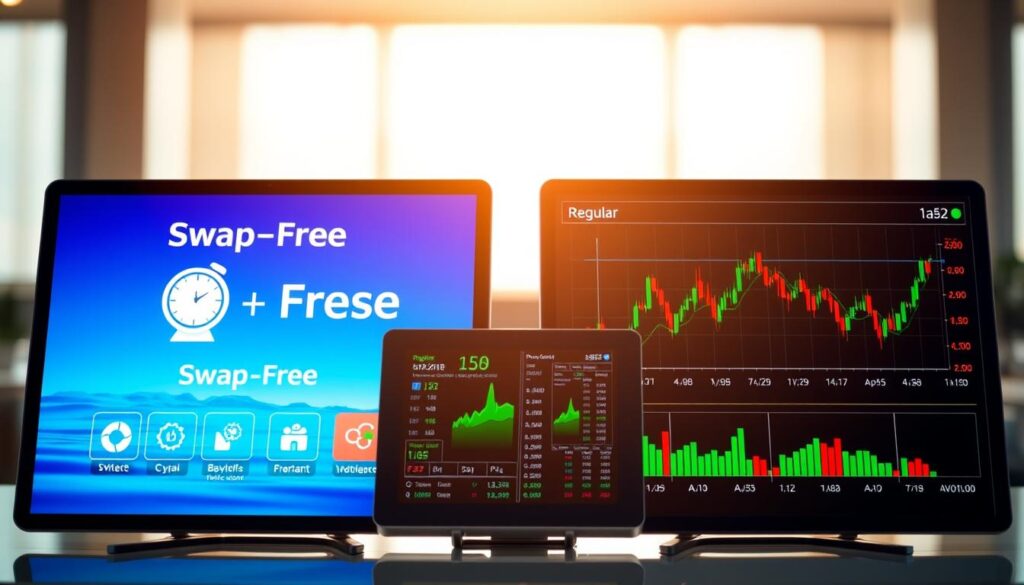
Often termed swap-free, these Islamic accounts remove all interest-based elements. They do not charge or pay rollover fees on positions held overnight.
This fundamental difference from standard trading accounts addresses the core issue of riba. All transaction costs are applied at the moment of trade execution.
Such immediate settlement reflects the required rapid transfer of currencies. It upholds the principles of Islamic trading.
Eliminating Hidden Charges and Ensuring Transparency
To compensate for waived swap fees, brokers adjust their pricing models. They typically introduce a slightly wider spread on currency pairs.
Some may apply a fixed administrative charge instead. These alternative charges are considered permissible service costs.
Full disclosure of all costs is mandatory for any account. This transparency allows users to verify that no hidden interest components exist.
The slightly higher cost is a conscious trade-off for maintaining religious compliance. It enables participation without compromising values.
Compliance with Sharia Law: Immediate Settlement and Hand-to-Hand Trading

Islamic scholars have adapted the concept of hand-to-hand exchange for today’s global, electronic trading environments. This classical principle required both parties to complete a transaction face-to-face in one session.
Its purpose was to prevent delays that could introduce interest or unfair advantage. In physical markets, this meant simultaneous transfer of currency or goods.
The Concept of Rapid Execution in Digital Trades
For modern markets, scholars have reinterpreted this rule. They determine that rapid electronic execution fulfills the same underlying objective.
Immediate settlement now means currency exchanges are processed instantly through digital systems. Both parties’ obligations are fulfilled simultaneously without any hold-ups.
This allows participants to engage in global markets while maintaining compliance with Sharia principles. All costs and fees must be paid transparently at the moment of trade execution.
Such an approach ensures no deferred obligations or interest-accumulating delays occur. This modern interpretation is a faithful application of the core Islamic principle to contemporary technology.
What Brokers Must Offer to Support Halal Trading Practices
To maintain religious compliance, market participants must carefully evaluate the services offered by their chosen platform. The right financial intermediary provides the structural foundation for faith-aligned activity.
Transparent Fee Structures and Regulatory Trust
A genuine Islamic account eliminates all interest-based charges. This swap-free feature is the core requirement. Reputable brokers clearly explain their Sharia compliance policies.
Costs must be fully transparent. Instead of swaps, a flat administrative fee or adjusted spread is permissible. These charges should be disclosed upfront without complex structures.
Regulatory oversight is a key trust factor. Selecting a broker licensed by authorities like the UK’s FCA ensures financial security. It also reinforces ethical standards.
Truly committed brokers offer educational resources about Islamic finance principles. This support helps users maintain compliance confidently.
Investors should verify that swap-free features are genuine. Some platforms merely use the label without substantive changes. High-quality brokers combine religious compliance with competitive execution and reliable platforms.
Addressing Misconceptions: CFD Trading, Margin, and Leverage in Islamic Finance

Market practices like CFD agreements and margin borrowing present distinct challenges for those seeking faith-compliant participation. It is vital to separate permissible activity from structures that inherently conflict with Sharia principles.
Risks Associated with CFD and High Leverage
CFD trading is generally viewed as non-permissible. This is because it involves speculating on price changes without owning the underlying asset. Such contracts lack the real economic exchange and equal risk-sharing required by Islamic law.
Using high leverage or a margin account often involves borrowing with interest. This directly contravenes the prohibition of riba. Even without interest, excessive leverage can create uncertainty that resembles gambling, falling under gharar.
Some platforms market “Islamic” versions of these instruments by merely removing swap fees. This does not fix the fundamental structural issues. Investors must look beyond labels to assess real compliance.
To identify when a practice may be haram, consider these points:
- Does the transaction involve actual ownership of an asset?
- Is the level of risk and uncertainty excessive, akin to gambling?
- Does the structure rely on borrowing with interest or hidden costs?
Genuine faith-aligned activity avoids these pitfalls, focusing on transparent, equitable exchanges.
Islamic Perspectives on Other Trading Instruments
Evaluating various financial instruments through the lens of Sharia law reveals a spectrum of permissibility. The core principles of Islamic finance apply consistently across different asset classes.
This analysis helps investors build diversified, faith-compliant portfolios. Each instrument must be assessed for adherence to key ethical rules.
Stock Trading vs. Forex Trading under Sharia Law
Equity investments in companies are generally permissible. This requires the business operates in halal industries and avoids significant interest-based income.
Investors must own actual shares and share both profit and loss. This represents real economic participation rather than pure speculation.
Fixed-income securities like bonds are prohibited. They generate returns through predetermined interest payments, contravening Islamic finance law.
Futures contracts typically violate the immediate settlement principle. Their deferred delivery dates introduce excessive uncertainty.
Cryptocurrency remains debated among scholars. Some view it as a legitimate digital asset exchange, while others cite extreme volatility and speculative nature.
The permissibility of any instrument depends on its structure and execution. A framework based on core principles allows for consistent evaluation.
Guidelines for Muslim Traders: Achieving Financial Success in Halal Markets
Achieving prosperity in the financial markets while upholding faith requires a disciplined and informed approach. This section offers actionable steps for those committed to ethical participation.
It focuses on integrating religious principles with sound financial strategies.
Ethical Trading Practices and Risk Management Strategies
Ethical practices form the cornerstone of faith-aligned activity. Market participants must avoid price manipulation and insider information.
All dealings should be transparent and honest. Treating this activity as a serious business, not entertainment, is crucial.
Risk management is both a financial and religious duty. Using stop-loss orders and sensible position sizing protects capital.
It also prevents activity from crossing into excessive speculation. Longer-term strategies, like swing trading based on analysis, align well with these values.
Learning Resources and Sharia Compliance Tips
Continuous education is essential. Muslim traders should study both market mechanics and Islamic finance principles.
Seeking guidance from knowledgeable scholars helps navigate new instruments. Developing a clear plan with entry and exit rules promotes discipline.
Focus on spot transactions with immediate settlement. Work with brokers who offer genuine swap-free accounts and full cost transparency.
These steps help ensure all market activities remain within permissible boundaries.
Navigating Regulatory and Market Standards in the United Kingdom
The regulatory framework in the UK provides a secure foundation for all market participants, including those seeking faith-compliant options. This environment ensures both legal clarity and strong consumer safeguards.
Regulatory Framework and Broker Compliance
Currency exchange activity is fully legal in the United Kingdom. It is overseen by the Financial Conduct Authority (FCA). This body is one of the world’s most respected financial regulators.
The FCA enforces strict rules on capital requirements and client fund segregation. UK-based brokers offering Islamic accounts must adhere to these same high standards. This ensures religious accommodation does not compromise financial security.
Many FCA-licensed brokers provide swap-free account structures. They serve the country’s significant Muslim population. Participants thus benefit from robust regulation and specialized services.
It is vital to verify a broker’s licensing status. Regulatory oversight provides essential recourse mechanisms. While authorities don’t certify religious compliance, they mandate full fee transparency.
This supports the principles of ethical finance. The best approach combines FCA regulation with a broker’s clear Islamic account terms. This dual focus aligns legal safety with faith-based values for trading in the market.
Final Insights on Embracing Halal Trading Practices
In summary, the path to faith-compliant participation in global currency markets is both clear and achievable. The central question of permissibility cannot be answered with a simple yes or no.
It depends entirely on how activities are structured and conducted. Practical solutions, like Islamic accounts that eliminate overnight interest, allow for participation without compromise.
Beyond account features, maintaining ethical practices and prudent risk management is crucial. This avoids excessive speculation and ensures transparency in all transactions.
Scholarly opinions vary, so seeking guidance from knowledgeable experts is wise. The growing availability of Sharia-compliant options reflects industry recognition of Islamic finance principles.
Ultimately, investors can successfully engage in global markets while upholding their religious values. Informed decision-making and adherence to core principles make this possible.