The world of finance is buzzing with activity. A global retail trading surge in 2025 highlights growing interest in diverse investment opportunities.
Both nationals and expats are exploring markets to grow their wealth. This guide provides a clear analysis to help you decide which asset class fits your goals.
Many participants wonder if they focus too much on one arena. They might miss chances in another volatile market.
We examine the core differences between these two popular assets. Our goal is to help you make informed decisions based on solid data.
Knowing the unique risk profile of each is crucial. It helps protect your capital in today’s economy.
This article clarifies how these major markets function. It cuts through the noise on volatility, liquidity, and capital needs.
By evaluating your personal strategy, you can better navigate the global financial landscape. Choose the battlefield where you are most likely to succeed.
Understanding the Basics of Gold and Forex Trading
Before diving into any market, understanding its core mechanics is essential. This foundational knowledge helps individuals navigate volatility and make informed choices for their portfolios.
Defining Gold Trading and Its Instruments
This activity involves the precious metal through various financial products. These include spot contracts, futures, and Contracts for Difference (CFDs).
It has served as a store of value for thousands of years. Today, participants can access it without holding physical bars, using digital platforms.
The metal’s price is influenced by global economic factors and sentiment.
Overview of Forex Trading and Currency Pairs
The foreign exchange arena is the largest financial market globally. It sees over $7 trillion traded each day, dwarfing other markets.
Participants buy one currency while selling another. These are quoted as pairs, such as EUR/USD or USD/THB.
Profit comes from fluctuations in exchange rates. It operates 24 hours a day across major financial hubs like London and Tokyo.
This is a pure financial instrument where no physical commodity changes hands.
Gold vs Forex Trading: A Direct Comparison
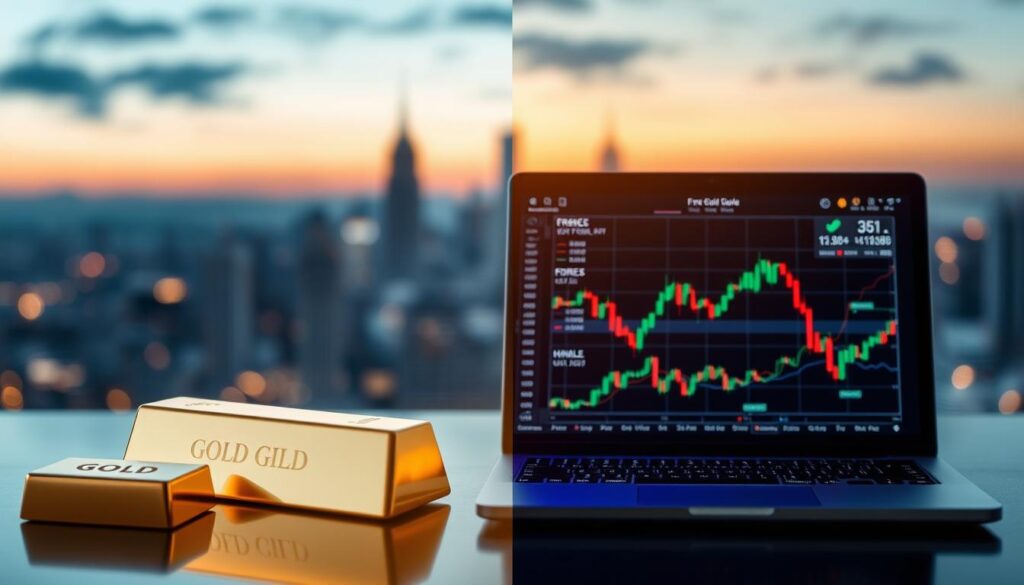
The decision hinges on recognizing the fundamental contrasts in how these assets behave. They are not simply different tickers on a screen.
Each arena has a unique origin and driver. Understanding this is the first step for any participant.
What Makes Each Market Unique
Think of the foreign exchange arena as a global sports match. It pits two national economies against each other.
Profit comes from predicting the relative strength of these teams. The precious metal, however, is like a universal trophy.
Its value is recognized globally, often measured against the US dollar. This metal is a physical asset with a history spanning thousands of years.
Currency markets react swiftly to central bank policies and economic reports. The other market is tied to global supply, demand, and sentiment.
Key Considerations for Traders
One major factor is the safe-haven role during crises. This can provide a hedge when other investments fall.
Successful traders must adapt their analysis and risk management for each structure. The underlying drivers are completely different.
Portfolio construction requires a tailored approach for long-term success. What works in one market may fail in another.
Market Structures and Trading Mechanisms
A trader’s first encounter with a market is through its quote. This system varies dramatically between asset classes.
Understanding these mechanics is vital for calculating risk and potential reward. It defines how you interact with the financial arena.
How Gold is Quoted Versus Currency Pair Pricing
In the currency market, a major pair like EUR/USD is quoted in pips. A move from 1.0850 to 1.0851 is a one-pip change.
The precious metal XAU/USD is quoted in dollars and cents per troy ounce. A shift from $2350.50 to $2351.50 is a one-dollar move.
The tick value and scale of movement are much larger for the commodity. This difference is crucial for precise position sizing.
The Role of Physical Assets and Digital Instruments
Historically, people bought physical bars from authorized dealers. This required storage and security.
Today, digital instruments like CFDs are dominant. They allow exposure to price movements without owning the physical asset.
Modern platforms and brokers offer this convenience. This revolution has changed how participants engage with global markets.
Adapting your mindset to each asset’s quoting scale is a key skill for success.
Price Movement Dynamics: Volatility and Average Daily Range
The Average Daily Range (ADR) provides a concrete measure of a market’s typical volatility. Understanding this metric is crucial for anyone involved in trading. It sets realistic expectations for daily price movement.
Gold’s Wild Swings Versus Forex Stability
The precious metal XAU/USD often has an ADR exceeding 2,500 pips. In contrast, a major currency pair like EUR/USD typically moves 60-80 pips daily. This means a standard session for one can be 30-40 times more volatile than for the other.
This dramatic difference defines the trading experience. High volatility creates significant profit opportunities but also amplifies risk. The metal’s prices can swing $40-$50 during major news events.
Understanding Average Daily Range (ADR)
The ADR shows how far an asset usually travels between its daily high and low. Traders use this data to manage risk effectively. Stop-loss orders must be placed with the ADR in mind.
A strategy that works for stable currency pairs will fail for the volatile metal. Mastering price action requires adapting to each market’s rhythm. This knowledge is a foundational skill for long-term success.
Liquidity, Spreads, and Execution Considerations
Behind every price quote lies a hidden cost that can silently erode potential gains. Understanding liquidity and transaction fees is crucial for protecting your capital.
These factors directly determine how much profit you keep from each move.
Comparing Liquidity in Gold and Forex Markets
The foreign exchange arena is the most liquid in the world. This immense volume allows for razor-thin costs on major currency pairs.
Participants can enter and exit positions with minimal price impact. The precious metal market is also highly liquid.
Its structure, however, leads to different transaction dynamics. This difference is fundamental for strategy selection.
Impact of Spreads and Execution on Profitability
For a scalper, the difference in costs can decide between success and failure. Major forex pairs often see fees below 1 pip.
In contrast, the metal XAU/USD typically ranges from 15 to 40 pips. Slippage is another critical factor.
This occurs when an order is filled at a worse price than expected. It is more common during volatile news events for the commodity.
A market order during a major report could be filled several dollars away. Always check the current spread before entering any position.
Choosing a broker with transparent pricing and tight fees maximizes profitability. This step is vital for both arenas.
Market Drivers: Global Economy and Central Banks

Central bank announcements and economic reports are the seismic events that send shockwaves through financial markets. Understanding these forces is not optional for anyone seeking to navigate price movements successfully.
Macro Economic Factors Influencing Gold Prices
The precious metal acts as a financial barometer. Its value rises with global uncertainty, inflation fears, and when real interest rates turn negative.
Real rates are nominal interest rates minus inflation. They have a critical impact on this asset’s appeal. A strong US Dollar, measured by the DXY Index, often pressures metal prices downward.
Central Bank Policies and Forex Movements
Currency markets live and die by interest rate differentials. When the Federal Reserve hikes rates while the ECB holds, the USD typically strengthens against the Euro.
Economic data like GDP and employment figures cause immediate volatility. For instance, the Worldwide Dirham’s peg to the US Dollar provides a stable base for regional participants.
Effective market participants must act as part-time economists. They analyze how central banks influence the value of major currency pairs. Grasping this “why” behind the price action is essential for anticipating future direction.
Leverage, Margin, and Capital Requirements
The rules of engagement change dramatically when comparing the capital needed for different assets. Leverage and margin are the tools that define how much market exposure one can control with their deposited funds.
Understanding Margin Differences
Brokers act as risk managers. They typically demand a higher margin for the precious metal compared to standard currency pairs like EUR/USD.
This is a direct response to the asset’s higher volatility. More collateral is required to hold a position through its wild price swings.
How Leverage Affects Risk in Each Market
Leverage allows control of larger positions with smaller capital. Firms like Defcofx offer ratios up to 1:2000, providing substantial flexibility.
This power is a double-edged sword. It magnifies both profit potential and the risk of significant losses.
A margin call occurs if account equity falls below the required level. This forces the broker to close open positions to protect itself.
Consequently, one needs a larger account to trade the metal with the same flexibility as currencies. Otherwise, they must use smaller position sizes.
Conservative participants often use lower leverage or wider stop-loss orders. This protects their money from normal market fluctuations. Choosing a ratio that fits one’s risk tolerance is essential.
Risk Management Strategies for Gold and Forex Trading
A staggering number of individuals lose money because they neglect a fundamental principle. Approximately 70-80% of retail participants fail, often due to emotional decisions and poor capital protection.
Mastering this discipline is the most critical skill for long-term success. Your approach must be tailored to the specific asset’s behavior.
Adapting Stop-Loss and Take-Profit Strategies
One size does not fit all. A 50-pip stop might work for a major currency pair like EUR/USD.
On the volatile metal XAU/USD, that same stop is a scalping tactic. It will likely be hit by normal price swings.
Stops for this commodity often need to be 500 to 1000 pips wide. This accommodates its large daily ranges without being prematurely stopped out.
Techniques for Precision Position Sizing
Position sizing should be based on your dollar risk per trade, not a random lot size. First, decide what percentage of your account you will risk.
For a $10,000 account risking 1%, your maximum loss is $100. You then calculate your position size based on the distance to your stop-loss.
Failing to adjust size for an asset’s volatility is a common error. It can quickly deplete an account during the metal’s wild swings.
Your overall strategy must respect these mechanics. Precise calculation protects your capital in any market.
Adapting Trading Strategies to Various Styles
A participant’s success often depends on matching their personal rhythm to the market’s tempo. Different approaches suit unique personalities, risk tolerance, and available time.
Selecting the right method is a critical step for consistent results.
Scalping, Day Trading, and Swing Trading Approaches
Each style engages with price action on a different timeframe. It requires specific tools and conditions.
- Scalpers execute many trades within minutes. They thrive on the tight costs and high liquidity of major currency pairs.
- Day traders hold positions within a single session. They can target both arenas, but the precious metal offers the chance for a large daily move.
- Swing traders hold for several days or weeks. They often prefer the trending nature of gold, setting wider stops to capture macroeconomic themes.
- Position traders analyze long-term charts. They may hold an asset for months, focusing on fundamental shifts.
Tailoring Strategies to Volatility and Market Conditions
The precious metal reacts strongly to global fear and inflation news. Currency movements are driven by interest rate differentials.
A strategy must be tailored to these distinct drivers. Tools like Renko charts can help filter out noise for swing participants.
Successful traders often specialize in one style and one market. This deep understanding typically outperforms chasing every short-term opportunity.
Your chosen approach should fit who you are and how the financial world behaves.
Considerations for Trading in Thailand Today
The surge in retail market participation across Southeast Asia brings both opportunity and responsibility. In 2025, activity is surging in regions like Thailand.
Individuals seek diverse opportunities in both precious metal and foreign exchange arenas. Success from this location requires specific local knowledge.
Local Market Insights and Capital Requirements
Understanding the local legal framework for this activity is non-negotiable. This includes tax implications for building a sustainable career.
Capital needs are a primary concern. The availability of local payment methods can significantly improve the overall experience.
The Role of Regulatory Environments and Broker Selection
Choosing a regulated partner is the most critical decision. These firms must maintain strict capital requirements and segregate client funds for safety.
Always verify a firm’s status with respected authorities. This ensures your capital is protected.
Key steps for selection include:
- Testing the platform with a demo account for interface and speed.
- Confirming responsive support is available in the local language.
- Avoiding unlicensed entities that operate without proper oversight.
Regulatory environments are designed to protect investors. By focusing on sound strategies and verified brokers, individuals can navigate the global financial landscape from anywhere in Thailand.
Wrapping Up the Insights on Gold vs Forex Trading
In the end, sustainable success in financial markets is less about picking the ‘best’ asset and more about personal alignment. The most profitable choice fits your unique personality, available capital, and strategic approach.
Gold offers explosive potential for those handling its volatility. Forex provides consistent opportunities for active day traders. Your journey hinges on managing risk, controlling emotions, and maintaining a disciplined approach to trading.
Do not chase headlines. Focus on mastering the data and understanding the core drivers of your chosen market. Many skilled traders use both gold and currency pairs to stay balanced and spread risk.
Ultimately, this activity is about continuous learning. Adapt your methods to the ever-changing global financial landscape. Ensure you have the right tools and knowledge for informed, objective decisions.