Learning to trade in the forex market takes time and skill. New traders need a safe place to learn before using real money. Forex demo accounts give traders exactly what they need.
These accounts let you practice trading with virtual funds while watching live market prices move.
A demo trading account works like a real trading account. The main difference is that you use pretend money instead of your own cash. ForexBrokers.com explains that these accounts allow you to test trading software without risking real capital.
You get to learn how platforms work and try out different strategies with no cost or danger involved.
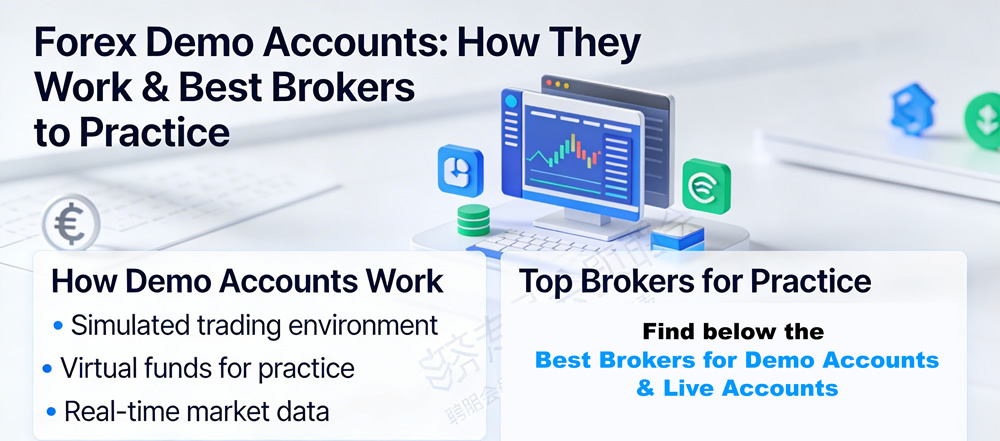
Most top forex brokers offer free demo accounts to new clients. IG provides a 5.0 out of 5 rating with just £1 needed to start. Interactive Brokers, Saxo, CMC Markets, FOREX.com, Charles Schwab, and XTB all offer demo accounts at no cost.
This means traders can find a good broker to practice with very easily.
ActivTrades notes that demo accounts use virtual funds paired with real market data. This setup gives traders a true sense of how markets work. You can test your skills in actual market conditions before putting your own money at risk.
Practice trading through a demo account helps beginners build confidence. You can learn platform features, test trading ideas, and develop your skills in a risk-free space. This article will walk you through how demo accounts work, why they matter, and which brokers offer the best options for traders.
Forex Demo Accounts for Beginners (Updated Guide)
What Is a Forex Demo Account?
A forex demo account is a special account for practice. Brokers give it to traders to learn without losing real money. Instead of real cash, traders use virtual funds to trade.
These accounts mimic real trading but are safe. They use fake money, or paper trading. Traders see real prices and market changes.
Brokers call these accounts different things. Some say demo, others paper trading. But they all help traders practice without risk.
Most accounts start with $10,000 to $100,000 in virtual money. Traders can try out different strategies. They learn the platform and build confidence without losing money.
- Access to real-time price quotes
- Same trading software as live accounts
- Virtual funds instead of real money
- Real market conditions and volatility
- Zero financial risk during practice
For traders, a demo account is like a sandbox. It’s a safe place to try out ideas and learn before using real money.
Why Every Beginner Should Start with a Demo Account

Beginner traders often feel overwhelmed when first entering the forex market. The learning curve can be steep. A demo account is perfect for those just starting.
This risk-free environment lets newcomers build confidence and develop essential skills. They can do this without worrying about losing money.
Forex trading practice through demo accounts helps beginners understand key concepts. They learn about currency pairs, position sizing, and leverage management. These concepts become real when experienced firsthand, not just read about.
Years ago, beginner traders had to learn through costly mistakes. Today, demo accounts are a big step forward in trader education. They let learners test strategies and see how fundamental factors affect currency movement.
Key benefits of starting with a demo account include:
- Building confidence in platform navigation and order placement
- Testing various trading strategies without financial risk
- Developing emotional control and trading discipline
- Discovering your preferred trading style and market focus
- Understanding chart analysis and indicator application
- Practicing risk management techniques safely
Demo accounts work best with educational resources. Reading articles, taking courses, and studying market analysis are more effective when practiced. This hands-on approach makes learning faster.
Demo vs Live Trading: Key Differences
There’s a big difference between demo and live trading accounts. Both use the same prices and platforms. But, trading with real money changes everything. Knowing these differences helps traders get ready for the challenges ahead.
The biggest difference is in trading psychology. Demo accounts don’t feel like real money, so traders can try more without worry. They might hold onto losing trades longer and take bigger risks. This confidence doesn’t last when trading with real money.
Market execution is another big difference. Demo accounts always fill orders perfectly. But live trading is different:
- Orders can get rejected in fast markets
- Spreads get wider during big news
- Large orders can slip in price
- Orders might not fill fully
Demo accounts don’t show these real-world issues. Live trading makes traders face challenges they can’t practice in demos. Seeing real money go up and down changes how they make decisions.
Trading with real money changes how traders think about risk. Traders who do well in demos might struggle with live accounts. Knowing these differences helps new traders set the right expectations and build strong trading psychology.
Forex Demo vs Live Account: Key Differences You Must Know
How Long Should You Use a Demo Account?
Many new forex traders wonder how long to use a demo account before going live. The answer varies based on how fast you learn, your trading goals, and how confident you feel. Everyone learns at their own pace when getting ready for the real market.
LiteFinance says traders should stay on demo accounts until they have a solid strategy. Demo accounts let you practice unlimitedly with fake money. This is great for learning advanced techniques and getting to know the market without risk.
It’s wise to do at least 50-100 trades to see how well your strategy works. You should also show you can make money consistently over 2-3 months. This proves your success isn’t just luck.
Important signs you’re ready to move to a live account include:
- Knowing the trading platform inside out
- Having a written trading plan
- Following risk management rules
- Staying disciplined emotionally
- Having realistic profit goals
ForexBrokers.com advises using demo accounts to learn software well. For testing strategies, they suggest a live account with small risks. Start with a gradual approach—begin with a small live account and then increase your capital.
Don’t stay on demo too long, or you might get too comfortable. But, moving too fast can lead to big mistakes. Find a balance between practicing and actually trading in the real market.
Plus500 Demo Account Review

Plus500 is a top CFD broker in the UK and Europe. It’s regulated by the Financial Conduct Authority. This makes it a safe place for traders to learn.
The demo account lets traders practice with fake money. They can try out many types of trades. This includes forex, indices, commodities, stocks, and cryptocurrencies.
The Plus500 platform is easy to use. It has features that help traders:
- Intuitive charting for analysis
- Many order types for strategies
- Guaranteed stop-loss for safety
- Tools for managing risk
The mobile app lets traders use their phones or tablets. They can check their trades and make new ones anywhere. The app works just like the desktop version.
Plus500 also has learning tools. These help users understand CFDs and trading basics. The demo is like a real account, with real spreads and fast execution.
Plus500’s demo is great for new traders. It’s simple and easy to learn. This makes it perfect for those just starting out.
For a step-by-step walkthrough of Plus500’s demo account, check out our full review
IC Markets Demo Account Review

IC Markets is a top Australian broker. It offers advanced trading conditions through its IC Markets platform. Traders get direct access to real market liquidity, not desk pricing.
Setting up a demo account with IC Markets is quick. You can choose from MetaTrader 4, MetaTrader 5, and cTrader. MetaTrader demo is popular for its familiar tools and customization.
- Selecting account type between Standard or raw spreads accounts
- Choosing leverage levels up to 1:500
- Setting initial virtual balance amounts
- Selecting preferred base currency
Raw spreads are great for cost-conscious traders. IC Markets earns from commissions, not spread markup. This means traders get real market conditions without price widening.
The IC Markets platform offers 60+ forex pairs, indices, commodities, bonds, and cryptocurrencies. Scalpers and algorithmic traders get low-latency execution and tight spreads. You can test different strategies with multiple demo accounts.
The unlimited demo account period makes IC Markets stand out. It lets traders practice as long as they need before using real money.
Learn more in our detailed IC Markets demo account guide for beginners and pros
FP Markets Demo Account Review
FP Markets is a top Australian broker with over 15 years of experience. It’s regulated by ASIC and CySEC, making it safe for traders. Its demo accounts offer a wide range of tools and resources.
Getting started with an FP Markets demo account is easy. Just provide some basic info and you’re in a practice trading world. This means beginners can start trading quickly.
The platform flexibility is a big plus. FP Markets has many trading platforms to suit different traders:
- MetaTrader 4 for classic, user-friendly trading
- MetaTrader 5 for advanced charting tools
- cTrader for professional-grade features
- IRESS platform for institutional-style trading
FP Markets has different account types in the demo. You can try Standard and Raw accounts with various spreads. The demo supports leverage up to 1:500 for risk management practice.
The instrument selection is vast. FP Markets offers over 10,000 tradeable instruments. This includes 60+ forex pairs, shares, indices, commodities, and cryptocurrencies. This variety lets traders explore different markets without switching brokers.
Educational resources are also available. Demo account holders get trading tutorials, live webinars, and market analysis. These resources help improve skills in a real trading environment.
Intermediate to advanced traders will find the FP Markets demo account great. It offers diverse platforms and a wide range of instruments for practice.
Read our complete FP Markets demo account analysis to see how it works in practice
AvaTrade Demo Account Review
AvaTrade is a well-known broker started in 2006. It offers a detailed demo experience. The broker is trusted in Europe and Australia, perfect for all traders.
The AvaTrade platform gives a 21-day demo with $100,000 in virtual funds. This lets traders test strategies without risk.
- AvaTradeGO mobile app for trading anywhere
- WebTrader for easy browser access
- MetaTrader 4 and MetaTrader 5 for detailed charts
- DupliTrade and ZuluTrade for automated trading demos
- AvaSocial for social trading
Automated trading demos are a big plus. Traders can try expert advisors and copy strategies from pros. This is great for learning from others without risk.
AvaTrade offers trading in 50+ forex pairs, CFDs, and more. It also has AvaAcademy for learning with video tutorials and eBooks.
Trading conditions include fixed and floating spreads. Leverage is up to 1:400 for retail clients. The main limit is the 21-day demo time, but it can be extended or reset.
Discover all the features in our AvaTrade demo account full guide
How to Choose the Right Demo Account
Choosing the right demo account is important. You need to think about what you want to learn and how you like to trade. Not all demo accounts are the same, so knowing what to look for is key.
Looking at the platform is a big step. You need tools that are professional and easy to use. A good demo account should feel like real trading. This means real spreads and fast execution.
- Instrument variety—choose brokers with the markets you want to trade
- Demo account duration—some offer unlimited access, others have limits
- Educational resources integrated into the platform
- Regulatory status and trust score ratings
- Mobile app availability for practice trading
Demo accounts should let you test strategies without risk. Look for unlimited practice and refillable funds. Also, find platforms with good educational materials and tools comparison.
For UK traders, checking if a broker is FCA-regulated is important. This ensures a smooth move to live trading. Interactive Brokers offers 150 markets in 34 countries. IG has nearly 20,000 symbols. Saxo has 71,000 instruments for advanced traders.
Beginners should look for easy-to-use platforms with lots of learning resources. Advanced traders might want more professional tools. Cost-conscious traders should look for brokers with tight spreads.
Final Thoughts: Which Demo Broker Is Best for You?
Choosing the right demo account depends on your experience and goals. Beginners should look at IG, ranked top by ForexBrokers.com. IG has easy-to-use platforms and great education through IG Academy.
IG also has strong customer support. Experts say IG has everything you need to learn.
For those with some experience, Interactive Brokers is a good choice. It offers advanced tools and strategies. Saxo is great for experienced traders with its top platforms and over 70,000 instruments.
CMC Markets is known for its charting with 12,000 markets. FOREX.com gives real-time prices and MetaTrader 5 access. These are the best for those looking for professional features.
Start by trying out different demo accounts. Open accounts at two or three brokers to compare. Spend two to three months practicing.
Keep a trading journal to track your progress. Charles Schwab and XTB offer great options. Automated traders should check out IC Markets or FP Markets for MetaTrader support.
The best demo account is one you use often. Move to a live account when you’re making consistent profits. Your suitability as a trader is key.
Some like social trading, while others prefer mobile trading. Find what works for you. The skills you build in demo trading will help you succeed.