Many people in the UK wonder about entering the world of currency exchange. The global foreign exchange market stands as the planet’s largest financial arena. Trillions of dollars move through it every single day.
This activity offers genuine profit potential for participants. However, it also carries substantial risks that demand respect. Proper education is essential before committing any money.
Safety here hinges on three critical factors. First, understanding the market‘s inherent volatility. Second, ensuring proper regulatory oversight from authorities like the FCA. Third, selecting a properly licensed broker.
Participant security does not depend on the arena itself. It relies on how an individual approaches it. Knowledge, regulated platforms, and disciplined strategy make the difference. This form of trade is legal and legitimate for UK residents.
This guide will examine key safety structures. It covers regulatory frameworks, broker selection criteria, and risk management techniques. The goal is to provide traders with practical strategies for a more secure experience.
Understanding the Forex Market Landscape
The global currency arena operates on a simple yet powerful principle: currencies are always exchanged in pairs. This structure defines every transaction and price movement.
Fundamentals of Currency Pairs and Exchange Rates
A currency pair shows the value of one money relative to another. The exchange rate is the live price for this swap.
These rates shift constantly with global supply and demand. Participants use platforms like TradingView to track movements and spot trends.
The Role of Leverage: Amplifying Gains and Losses
Leverage lets people control large positions with a small deposit. It works like a loan from the broker.
This tool can magnify profits dramatically. It also multiplies losses just as fast. Ratios vary, with some regions allowing much higher leverage than others.
Is Forex Trading Safe? Evaluating Risks and Rewards

Currency markets present a landscape where potential gains walk hand-in-hand with significant dangers. A genuine evaluation of security here requires balancing the promise of profit against the reality of risk.
Assessing Market Risks and Unexpected Volatility
Inherent risks exist for every participant. Sudden events can trigger extreme market moves.
On January 15, 2015, the Swiss National Bank shocked global markets. It abandoned its currency cap, causing the Swiss franc to soar 41% in minutes.
This unexpected volatility inflicted hundreds of millions in losses. It bankrupted brokerages and pushed major firms toward insolvency. The event shows how central bank decisions create devastating risk.
Balancing Potential Profits Against Exposure
Leverage magnifies every currency move. A modest shift can result in a massive gain or loss on the position.
Many retail traders face an asymmetric problem. They secure small profits on many trades but hold one losing position too long.
That single loss can erase an entire amount of previous gains. Statistics show most aspiring participants do not survive forex trading for long.
Returns are never guaranteed. The decentralized, 24-hour nature of these markets demands constant vigilance from every trader.
Navigating Forex Trading Risks through Proper Strategy

The difference between lasting participation and a short-lived attempt often lies in strategic preparation. A proper strategy provides a roadmap for handling the currency market‘s unpredictable nature.
Effective Risk Management Techniques
Core risk management begins with position sizing. Seasoned traders risk only 1-2% of their capital on any single trade. This rule ensures no individual loss can cripple their account.
Stop-loss orders are a fundamental tool for limiting losses. They automatically close a position at a predetermined price. However, these orders have clear limitations during extreme events.
When the Swiss franc surged in 2015, liquidity vanished. Many stop-loss orders failed to execute at expected prices. This historical event highlights a critical risk.
A robust strategy also targets favorable risk-to-reward ratios. Professionals aim for potential gains that are two or three times larger than potential losses. This math allows them to be wrong often but still profit over time.
Learning from Historical Market Movements
The 2015 “Swiss Shock” teaches a vital lesson about leverage. High leverage can deplete capital instantly during unusual market volatility. Experienced forex traders use only a fraction of the maximum available.
Proper management requires keeping a detailed journal. Reviewing both winning and losing trades provides objective data. This practice helps a trader refine their approach based on evidence, not emotional reactions.
Regulatory Oversight in the UK: The FCA and Forex
The Financial Conduct Authority stands as the guardian of market integrity for UK-based traders. This powerful body oversees hundreds of brokers operating within the British financial arena.
Globally, only about half of all currency brokers hold proper regulation. This stark reality exposes participants to potential fraud from unlicensed firms.
How the FCA Protects Traders and Ensures Compliance
The FCA requires every broker to obtain explicit authorization. Its rigorous licensing process assesses a firm’s financial stability and business model.
Core protections focus on safeguarding client money. Regulated entities must keep customer funds in segregated accounts. They also maintain minimum capital reserves.
Active monitoring ensures ongoing compliance. The authority imposes significant penalties for violations. One firm received a £276,000 fine for unauthorized investment advice.
Combating fraud and manipulation remains a priority. In 2015, five major banks faced nearly $6 billion in fines for exchange rate manipulation.
Traders can verify any firm’s status using the FCA’s online Financial Services Register. This tool confirms legitimate authorization instantly.
Historical cases, like Secure Investment’s disappearance with over $1 billion in client funds, highlight the critical need for this oversight. Strong regulation provides the foundation for secure participation in currency markets.
Choosing a Regulated Broker for a Secure Trading Experience

Before placing a single trade, every participant must complete a vital piece of due diligence: broker verification. This choice forms the bedrock of operational security in the currency market.
Selecting a regulated broker licensed by the Financial Conduct Authority is non-negotiable. The FCA authorizes firms under specific license types, each with strict capital rules.
Verifying Broker Licensing and Capital Requirements
UK brokers operate under licenses like Proprietary Trading or Agency Model. The FCA mandates minimum capital reserves for each.
Routine investigations confirm a firm’s proof of funds. This ensures liquidity for client withdrawals. The authority can suspend a license if standards slip.
Client money must stay in segregated accounts, separate from the broker’s operational funds. This protects a trader’s deposit.
The Importance of Investor Compensation Schemes
The Financial Services Compensation Scheme offers a critical safety net. It covers client deposits up to £85,000 per person if a regulated broker fails.
This scheme protects against firm insolvency. It *does not* cover losses from poor trades or market moves. Verification of FSCS membership is a key final check before opening an account.
Optimizing Trading Execution with Reliable Platforms
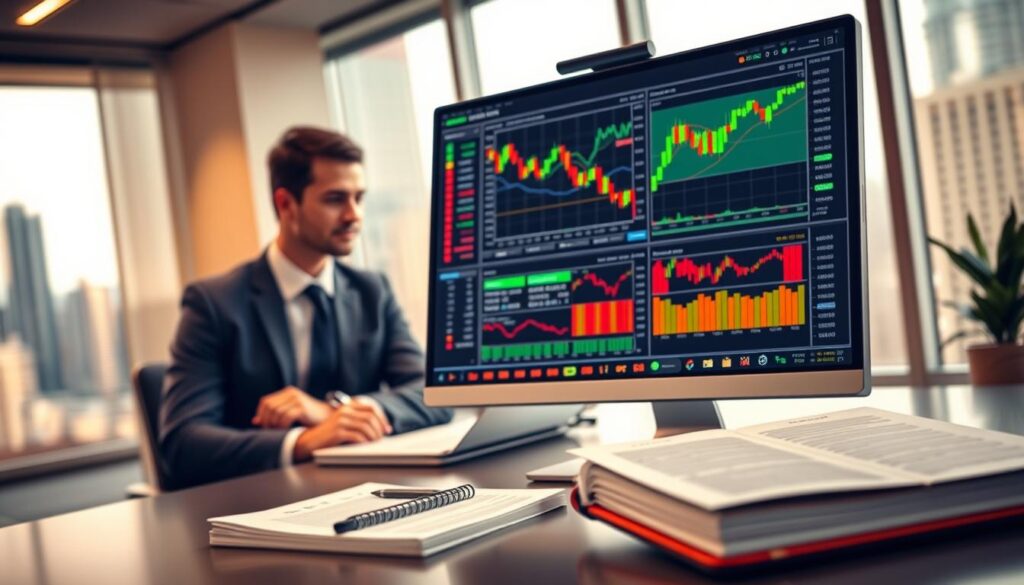
In the fast-paced world of currency markets, a robust platform is not a luxury but a necessity. The choice of software directly impacts order execution speed and the overall participant experience.
Utilizing Powerful Charting Tools and Analysis Software
Professional participants rely on advanced charting software. Tools like TradingView deliver real-time price information and comprehensive analysis.
These platforms provide essential features for success. Real-time price feeds, fast order execution, and multiple order types are critical. Comprehensive charting tools allow for deep technical examination of currency pairs.
System reliability presents a significant operational risk. A power outage or internet failure can prevent closing a critical trade. This technical vulnerability can lead to substantial losses.
During periods of extreme market volatility, even reliable systems may falter. Liquidity can vanish, causing prices to gap beyond stop-loss orders. Slippage and execution delays become real dangers.
Testing a platform’s functionality with a demo account is a vital step. This practice builds familiarity with the interface and tools without financial risk.
Additional features greatly enhance the user experience. Mobile applications, customizable price alerts, and integrated news feeds keep traders informed. Staying updated with market-moving events is crucial.
Smart participants always have a backup plan. Maintaining accounts with multiple brokers or an alternative internet connection ensures access. This preparation manages the risk of primary platform failure.
Crafting a Profitable Forex Trading Plan
A well-defined blueprint separates successful currency market participants from those who struggle. This document outlines specific rules for every action taken.
Developing a Structured Trading Strategy
An effective plan includes clear entry and exit criteria. It defines position sizing rules and risk-per-trade limits.
Realistic profit targets based on market analysis guide decisions. This strategy turns emotional reactions into disciplined execution.
Practicing with Demo Accounts Before Real Investments
A demo account provides a risk-free environment for testing. Traders can execute trades using virtual money.
This practice builds familiarity with platform tools. It helps identify which approaches generate consistent returns.
Treat the demo with the same discipline as a live account. Use identical position sizes and management rules.
Most successful participants spend months on demo before committing real investment. Rushing into live markets often leads to substantial losses. Continuous refinement based on journal reviews is essential.
Final Reflections on Embracing Safe and Informed Forex Trading
The sheer scale of daily currency exchange does not automatically translate to individual safety. Security here stems from personal discipline and management, not market size.
Over $7.5 trillion in currencies trade each day. Yet, most aspiring traders fail to secure consistent profits. Many even lose substantial sums of money.
Choosing an FCA-regulated broker remains essential. This ensures segregated funds, capital requirements, and compensation scheme access.
For those determined to participate, key safeguards apply. Limit leverage, maintain tight stop-loss orders, and select a reputable brokerage.
With proper knowledge, regulated platforms, and unwavering risk control, forex trading offers legitimate profit potential. It demands significant time for education before committing real capital.