The ninth month of the Islamic calendar, based on lunar cycles, ushers in a period of profound spiritual observance. This holy month significantly influences financial behavior across nations with substantial Muslim communities.
Activity in financial exchanges often undergoes noticeable shifts at this time. Empirical evidence reveals distinct liquidity patterns and volatility metrics that diverge from regular intervals.
Despite typically lower participation volumes, many Muslim-majority financial markets demonstrate historically higher returns. Concurrently, they frequently exhibit reduced price volatility.
Comprehensive research covering fourteen countries, where Islam constitutes the majority faith, provides these insights. The analysis utilizes broad stock index data accessible through exchange-traded funds (ETFs).
This convergence of spiritual practice and financial participation creates distinct opportunities. Informed market participants can navigate these conditions with strategic awareness.
Understanding the Ramadan Trading Landscape
A lunar calculation system means Ramadan occurs approximately 10-11 days earlier each successive year. This shift relative to the solar Gregorian calendar directly impacts financial planning cycles.
The spiritual focus of these months fosters a unique mindset. Many participants experience heightened mindfulness and self-discipline.
This calm, reflective state can influence financial decision-making. An investor’s behavior may become more deliberate and risk-aware.
Daily routines adapt to accommodate prayer and community meals. Consequently, participation in the market often follows distinct hourly patterns.
This convergence of spiritual practice and economic activity creates a special environment. Successful navigation requires understanding these cultural and calendar-based rhythms.
Decoding Market Liquidity Trends During the Ramadan Month
Empirical research points to a measurable decline in the number of shares changing hands on certain days. This shift in trading volume is a defining feature of the market landscape.
Liquidity Patterns in Predominantly Muslim Countries
As daily routines transform, economic activity adjusts. This leads to lower participation on local stock exchange platforms.
The magnitude of this decline varies. It depends on local market characteristics and the proportion of the Muslim population.
Comparative Analysis of Stock Market Volume
Studies use index data from nations where Islam is the majority faith. This allows for a clear comparison of volume metrics.
A lower trading volume environment has several practical effects:
- Wider bid-ask spreads on many assets.
- Reduced market depth for large orders.
- Potential challenges in execution quality.
This analysis helps investors using an equally weighted ETF strategy. They can better anticipate trading conditions and costs.
Evaluating Volatility Metrics and Statistical Insights

A review of global financial data uncovers a period of enhanced stability. This section delves into the quantitative assessment of market behavior. It evaluates key volatility metrics and presents statistical insights derived from extensive analysis.
Descriptive Statistics and Research Findings
Descriptive statistics provide a clear picture of central tendencies and dispersion. Research findings consistently show higher mean returns coupled with lower standard deviation.
This combination improves risk-adjusted performance metrics, such as the Sharpe ratio. A comprehensive study synthesizes this data from multiple markets.
The results highlight a pattern of reduced price swings. This statistical evidence is robust across different time periods.
Empirical Evidence from Global Markets
Empirical evidence from multiple studies across various nations supports these observations. Data indicates fewer instances of panic selling and reduced extreme price movements.
The results point to a calmer market environment during this time. This evidence suggests a link between collective mindfulness and financial stability.
Academic research on stock returns offers compelling support. These studies provide a data-driven foundation for understanding seasonal effects.
islamic trading during ramadan: Market Timing and Risk Management

Market timing strategies seek to optimize portfolio performance by adjusting exposure based on forecasted conditions. A specific approach involves holding an equally weighted basket of equity ETFs only in a particular month.
This tactical method aims to capture historically favorable conditions while avoiding other periods. It represents a form of strategic asset rotation.
Strategies for Equity Market Timing
The core idea is straightforward. An investor maintains full exposure to the equity market for a defined window.
Outside this period, capital is held in cash. This targets the equity market factor when its return profile is most attractive.
The goal is to participate only during positive phases for stock prices. Historical data from certain regions informs this seasonal strategy.
Risk Mitigation through Cash Holdings
Holding cash serves as a primary defense. It reduces overall portfolio volatility and protects against drawdowns.
This cash provides liquidity for the next investment cycle. Key implementation considerations include:
- Portfolio rebalancing mechanics.
- Transaction cost impact.
- The opportunity cost of being out of the market.
While it can improve risk-adjusted returns, the strategy requires careful execution. Costs and tax implications must be evaluated.
Ethical Wealth Management Considerations in Ramadan Trading
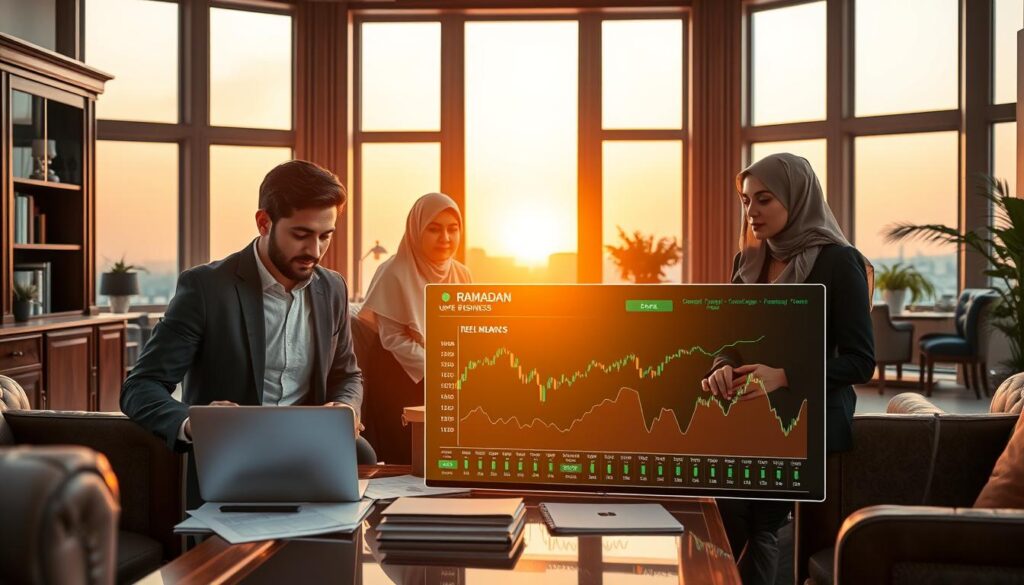
Wealth management takes on a distinct ethical dimension during periods of spiritual observance. Many individuals reassess their financial habits to ensure alignment with core principles.
Managing capital ethically involves avoiding interest and ensuring just wealth circulation. This approach shapes decisions in unique ways.
The Role of Zakat and Sadaqah in Financial Ethics
Zakat is a central pillar, requiring a 2.5% annual wealth distribution. This act purifies savings and supports community welfare.
Many choose these months for payment, believing spiritual rewards multiply. Sadaqah represents voluntary charity without a fixed rate.
Financial institutions now facilitate these practices. They offer fee waivers for charity transfers during this time.
Shariah-Compliant Investment Solutions
Halal investment options focus on permissible sectors. These include real estate and agriculture, avoiding prohibited industries.
An investor might review their stock portfolio to ensure compliance. The role of religious beliefs is central here.
Murabaha-based financing provides short-term, interest-free alternatives. This allows for needs without compromising ethics.
This ethical framework serves a dual purpose. It maintains principled compliance while engaging with the market.
Case Studies from Muslim Countries and Stock Exchanges
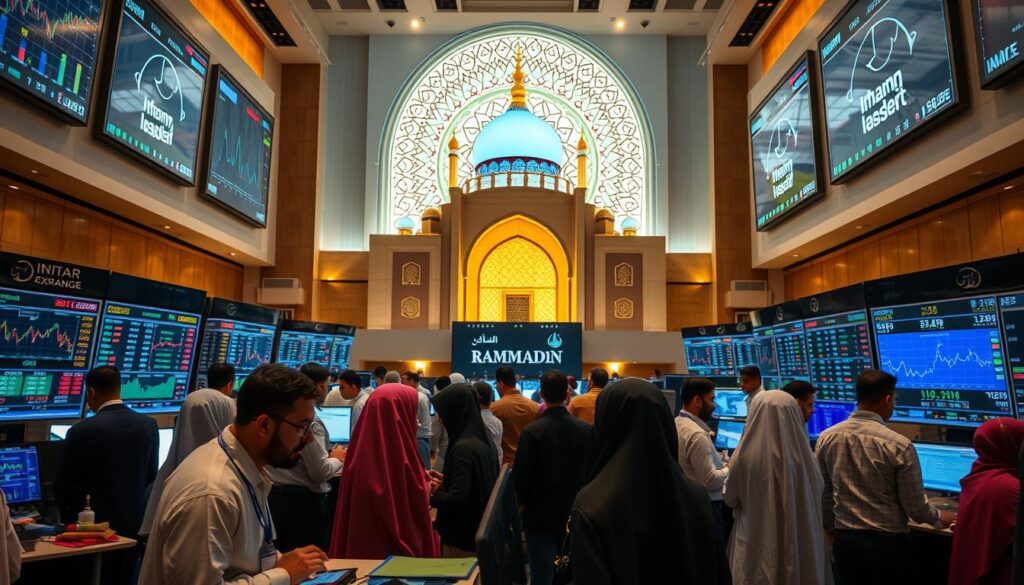
Concrete examples from specific nations provide the clearest evidence of seasonal market shifts. A detailed case analysis reveals how these patterns play out on the ground.
Research Insights from Saudi Arabia and Beyond
Saudi Arabia serves as a prominent case study. Its well-developed stock exchange shows clear historical data for analysis.
The research covers fourteen muslim countries. It tracks index performance to identify consistent trends.
Markets in the Middle East, Southeast Asia, and North Africa show similar but varied patterns. The strength of the ramadan stock effect differs between countries.
This study finds markets with higher Muslim investor participation see more pronounced changes. Stock returns and volatility metrics shift noticeably.
International investors can access these muslim countries through index ETFs. This makes the strategy practical for a global audience.
The case of Saudi Arabia is particularly instructive for strategy formation. Other stock exchange hubs offer compelling opportunities too.
Adapting Trading Strategies for Lower Trading Volumes

This unique environment turns operational challenges into strategic opportunities. A decline in participation requires a deliberate shift in execution tactics.
Patient investors can navigate thinner markets by making key adjustments. Essential changes to standard practice include:
- Prioritizing limit orders over market orders for price control.
- Breaking large positions into smaller trades to minimize impact.
- Timing executions to coincide with expected liquidity windows.
The calmer stock market atmosphere can benefit a long-term investor. With reduced noise, fundamental factors may exert a stronger influence on stock prices.
This period is ideal for review and education, not just active execution. An investor should use the time to refine their overall strategy and plan future market engagements carefully.
Impact of Islamic Banking and Fintech Initiatives on Market Behavior

A quiet revolution in digital finance is making ethical participation more straightforward for millions. Financial institutions and tech platforms now play a vital role in shaping investor behavior.
They provide tools that align financial activity with personal values. This support is especially relevant according to the Islamic calendar.
Innovative Shariah-Compliant Financial Tools
Islamic banking initiatives have removed practical hurdles. Key services include waived fees for charitable transfers and promotional investment products.
These options allow for short-term, interest-free financing needs. They make managing wealth according to principle much easier.
Fintech apps have added another layer of convenience. Mobile features now include integrated Zakat calculators and automated donation settings.
Global platforms offer specialized accounts operating in over 180 countries. These accounts provide transparency, fast execution, and avoid swap fees.
Such features reduce barriers for participants. Easier access to compliant tools likely encourages more activity in the stock market.
This technological shift supports a more deliberate and informed approach to the market. It integrates faith-based practices seamlessly with modern trading.
Leveraging Analytical Tools for Informed Trading Decisions
A systematic approach to market participation hinges on robust data analysis and reliable tools. Modern platforms provide a full-fledged analytical toolkit for this purpose.
They offer features like commission-free transactions and tight spreads. These platforms consistently deliver transparency and lightning-fast order execution.
Free demo accounts allow practice without risk. This is invaluable for familiarization with unique market dynamics.
Access to real-time data and historical return patterns empowers an investor. It helps identify optimal entry and exit points for stock positions.
Specific techniques are particularly useful. Volatility analysis can confirm a calmer environment, while volume analysis pinpoints the best execution windows.
This evidence-based method aligns with a period of heightened discipline. It helps avoid impulsive decisions driven by emotion.
Thorough research before any trading decision is crucial. It supports the principle of transparency and maximizes risk-adjusted returns.
Analyzing past results provides concrete evidence for strategy validation. A systematic review of stock return patterns can strengthen confidence.
Ultimately, leveraging these tools ensures decisions are made with full awareness. This reflects a conscientious and accountable approach to all financial activities.
Integrating Shariah Principles with Financial Analysis
Ethical finance rests on core prohibitions against interest and excessive speculation. This framework guides how an investor analyzes the stock market.
Ensuring Halal Investment Practices
Halal practices require rigorous screening of companies. Businesses involved in prohibited sectors or with excessive debt ratios must be avoided.
The system favors equity-based structures like Mudarabah and Musharakah. These promote risk-sharing over debt-based financing.
Avoiding Riba and Excessive Uncertainty
Riba, or interest, is strictly forbidden. Compliant accounts eliminate swap fees and overnight interest charges.
Gharar prohibits excessive uncertainty. It discourages speculative derivatives and favors immediate spot trading.
Excessive risk-taking is equated with gambling. Prudent position sizing and thorough analysis are essential.
The relationship between religious beliefs and financial choices is fundamental. Practical steps include portfolio reviews and using Shariah-compliant accounts, particularly noted on the islamic calendar.
Reflecting on Ramadan Trading Trends and Financial Growth
The collective evidence points to a reliable calendar-based anomaly influencing equity performance. This Ramadan effect is a persistent pattern documented across multiple stock markets.
Extensive research confirms superior returns and lower volatility in this month. This dual impact stems from altered investor sentiment and more deliberate behavior.
The effect is most pronounced in nations with a Muslim majority. The data shows a clear relationship between observance and market stability.
Understanding this seasonal pattern offers a strategic lens for portfolio management. Investors can integrate this insight with thorough analysis for informed decisions. Continued observation of these calendar trends remains valuable for long-term financial growth.