Since 2005, one broker has worked to open global financial markets for everyday investors. This firm provides a platform where individuals can trade various assets.
For any participant, understanding this tool is a critical first step. It acts as a powerful tool that can amplify potential gains from price movements.
It is crucial to remember this magnification works both ways. A disciplined approach is non-negotiable to protect one’s capital.
In the United Kingdom, safety is a priority. The Financial Conduct Authority sets strict leverage limits for all retail clients. This ensures a safer trading environment for everyone.
Newcomers looking to start trading must grasp these concepts. Effective use requires respect for the risks and the rules designed to guard your investment.
Introduction to Leverage in Financial Markets
At its core, leverage in trading is about controlling a large position with a modest initial investment. This fundamental tool shapes how individuals interact with global finance.
Understanding Basic Leverage Concepts
It allows a participant to control a position much larger than their deposited capital. For example, a small amount of money can govern a trade with a significantly higher total value.
This magnification affects every price shift. While it can boost potential gains, it also means even a minor adverse move poses a substantial risk. Traders must respect this double-edged nature from the start.
The Role of Leverage in Modern Trading
In today’s environment, this tool provides access to greater market exposure. It enables strategies that would otherwise require a much larger account balance.
Careful evaluation is non-negotiable. Successful participants constantly assess their exposure to ensure they do not overextend their financial resources. This disciplined approach is a hallmark of savvy trading.
Fundamentals of fp markets leverage
For participants in the UK, a solid understanding of leverage fundamentals is the first step toward informed trading. These core ideas explain how a broker’s platform can magnify market exposure.
A trading account operates using a key concept: the margin requirement. This is a fraction of the total trade value that must be deposited. It grants access to larger positions than the account balance alone would allow.
Definition and Key Components
The mechanism hinges on the relationship between deposited collateral and total position size. This ratio determines the amplification power applied to any price movement.
Understanding this dynamic is essential for managing risk in financial markets. It transforms a modest investment into a more significant trading activity.
Relevance for UK Traders
The Financial Conduct Authority imposes strict protections for retail clients. For major currency pairs, leverage is restricted to a maximum of 30:1.
This rule is designed to shield traders from extreme volatility. Traders must monitor their account equity closely to avoid margin calls. Clear guidance from the provider ensures everyone comprehends these vital parameters.
Exploring Maximum Leverage Ratios

A key figure for any trading account is the maximum leverage ratio permitted by the provider. This number sets the absolute limit for how much market exposure one can command with their deposited funds.
It acts as a critical boundary for planning. Traders must operate within this ceiling to manage their capital effectively.
What Maximum Ratios Mean
In practical terms, the maximum leverage ratio defines the highest multiplier applied to a trader’s capital. It directly dictates the margin required to open a new position.
A common ratio like 30:1 means that for every £1 in margin, one can control a £30 position. This relationship is fundamental to understanding potential profit and loss scales.
Choosing a lower ratio than the maximum is a prudent risk management step. It reduces the amplification of both gains and losses on each trade.
How Ratios Are Calculated
The calculation for a specific leverage ratio is straightforward. One divides the total position value by the margin amount needed to open it.
For example, a £10,000 trade with a £500 margin deposit results in a 20:1 ratio. This simple math reveals the exact level of financial commitment versus control.
Understanding this calculation is vital. It shows how even a small change in the margin amount significantly alters the ratio and the associated risk.
Managing Margin and Mitigating Risk

A trader’s journey is safeguarded not by predicting the market, but by meticulously managing their margin exposure. This practice is the bedrock of long-term participation in financial markets.
Constant vigilance over your account’s margin level is essential. It ensures you have the necessary buffer to handle normal price swings. Effective risk management hinges on this daily discipline.
Avoiding Margin Calls
A margin call is a protective mechanism triggered by the platform. It occurs when your account equity drops below the required margin level for open positions.
To prevent this, traders must maintain sufficient additional funds. This extra capital acts as a shock absorber during periods of high volatility. Avoiding a margin call preserves your control over trades.
Safeguarding Your Capital with Proper Funds
Protecting your investment starts with a healthy account balance. This balance should be large enough to absorb potential losses without forcing the liquidation of trades.
Regular monitoring of your margin usage is a core risk management strategy. It helps keep the account within safe operational limits. Using lower leverage ratios can also reduce margin pressure.
By keeping adequate funds available, you avoid the stress of a margin call. This discipline allows you to maintain control over your long-term trading strategy and capital.
Optimizing Your Trading Account for Leverage

A well-optimized trading account is the cornerstone of effective leverage use. It balances opportunity with control. This process requires a strategic assessment of personal risk tolerance and desired market exposure.
Traders should configure their account settings to align with specific financial goals. This ensures margin usage stays within a comfortable and manageable range. A clear plan prevents overextension.
Regular review of account performance is crucial. By analyzing results, participants can adjust their use of gearing. This helps maximize potential profit while minimizing unnecessary risk.
Proper optimization involves setting firm boundaries. Decide how much amplification to apply to each individual trade. These limits protect your core capital from excessive drawdown.
A well-tuned account provides the flexibility needed for changing conditions. It allows for strategic trading while safeguarding your financial foundation.
Leveraging Trading Platforms and Demo Accounts

Before committing real funds, many participants choose to hone their skills in a simulated setting. The right software and a practice account are invaluable for anyone using gearing.
Choosing the Right Trading Tools
Advanced trading platforms provide essential features for modern participants. These tools deliver real-time data and sophisticated risk management functions.
Reliable software ensures precise order execution during volatile periods. Strong customer support helps users navigate complex features and resolve issues quickly.
Access to professional-grade tools is a significant advantage. It allows for confident strategy execution across various assets.
Benefits of Utilizing a Demo Account
A demo account offers a completely risk-free environment. Traders can practice with virtual funds and test different approaches.
This safe space builds essential confidence before live trading. Newcomers refine their skills without any capital at risk.
Utilizing a practice account is a smart first step. It provides hands-on experience with platform tools and order types.
Excellent customer support often extends to these simulated accounts. This ensures users gain full access to educational resources.
Risk Management: Position Size and Stop-Loss Strategies
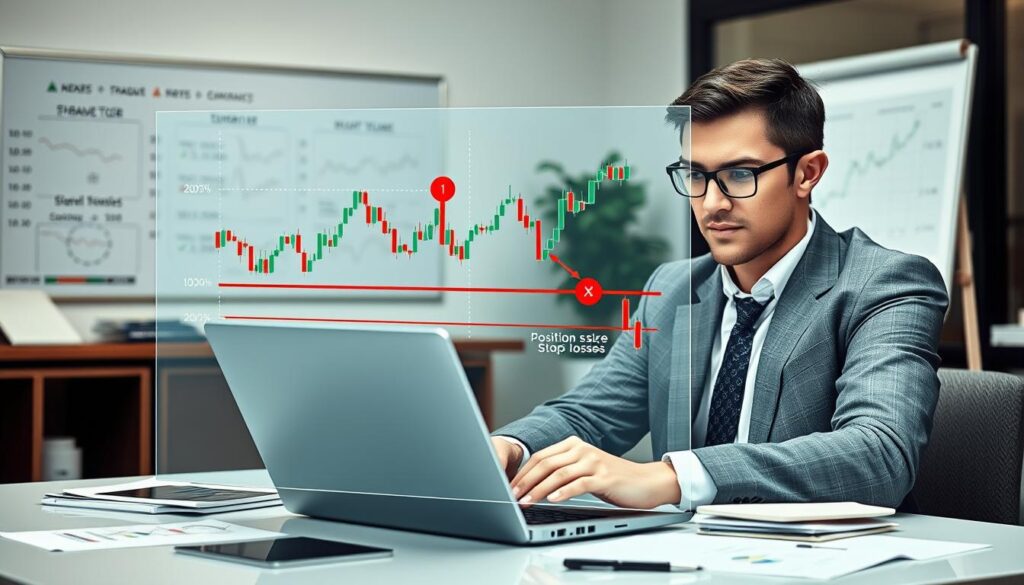
A trader’s long-term survival depends more on managing potential losses than on chasing maximum profits. This principle is especially true when using amplified trading tools. Two techniques form the bedrock of this discipline: calculating precise position sizes and setting strict stop-loss orders.
Determining an Appropriate Position Size
Determining an appropriate position size is the most critical aspect of risk management. It directly controls how much capital is exposed on any single trade. This calculation becomes even more vital when using financial gearing.
A trader must calculate the position size based on the distance to their stop-loss in pips. This ensures that potential losses remain within a predefined limit. For example, a wider stop-loss requires a smaller position to keep the risk constant.
By setting a strict stop-loss order, a trader can protect their account from significant price swings. This automated order closes a position at a specific level to cap the loss. It acts as a safety net against unexpected market moves.
Managing the size of each position helps to mitigate the impact of gearing. It ensures no single trade jeopardizes the entire account balance. Consistent application of these strategies allows traders to stay in the market longer.
Integrating Leverage with Diverse Financial Instruments
The true power of amplified trading emerges when it is applied across a wide array of asset classes. A leading provider grants access to over 10,000 financial instruments. This vast selection includes forex pairs, shares, and CFDs.
Diversification across these assets helps manage overall portfolio risk. Each instrument type reacts differently to market price changes. Traders must adapt their gearing strategy for each one.
Strategies for Forex Trading and CFDs
In forex trading, participants often use gearing to control large currency positions. Major pairs like EUR/USD can be traded with a relatively small margin amount. This allows for significant exposure to global economic shifts.
Contracts for Difference (CFDs) offer a unique advantage. They enable speculation on both rising and falling price movements. Using this tool, a trader can potentially profit in various market conditions.
Exploring Opportunities with Shares and Other Instruments
When trading shares with gearing, a deep understanding of the underlying company is crucial. Share prices can be volatile based on earnings reports and news. Many choose to use lower ratios for these assets to mitigate risk.
Key considerations for using gearing across different instruments include:
- Volatility levels of the specific asset
- Correlation between different holdings in your portfolio
- The margin requirements set by your broker
With thousands of options, every participant can find suitable opportunities. Matching the right instrument with a prudent gearing level is the final step.
Key Takeaways for Safe Leverage Trading
Successful navigation of the financial markets hinges on a few foundational principles every trader should internalize.
Safe trading with leverage demands a disciplined approach. Traders must prioritize risk management over the pursuit of quick profit.
Always maintain additional funds in your account. This buffer covers potential margin requirements during volatile market periods.
Remember that higher leverage magnifies exposure. Even small price movements can significantly impact your total trading position.
Utilize educational tools and demo accounts to refine your strategy. Practice builds confidence before you start trading with real capital.
By maintaining a balanced view and adhering to strict position sizing, traders can use trading leverage effectively to achieve their financial goals.