Founded in 2007 in Sydney, Australia, IC Markets has rapidly become a global leader in the trading industry. With over 1980 financial products available, including Forex and precious metals, it offers traders a diverse range of options. The firm processes an impressive US$ 2.05 trillion in average monthly volume, reflecting its significant market presence.
IC Markets is regulated by the Financial Services Authority of Seychelles (FSA), ensuring a secure trading environment. This regulation means that client funds are held in segregated accounts, providing an added layer of protection. New users can open an account to experience the benefits of high ratios while adhering to strict risk management protocols.
Traders can access over 61 currency pairs with institutional-grade liquidity and rapid execution speeds. With support available 24/7, IC Markets is dedicated to assisting clients in navigating the complexities of the trading world.
Understanding Leverage in Forex Trading
In the dynamic world of Forex trading, understanding the concept of leverage is crucial for success. Leverage enables traders to control larger positions with a smaller amount of capital. This powerful tool can significantly enhance trading potential but comes with its own set of risks.
IC Markets offers leverage ratios ranging from 1:1 to 1:1000 for eligible clients. This flexibility allows traders to customize their exposure based on individual risk tolerance. Here are some key points to consider:
- With a 1:1000 ratio, a trader can control a position of 100,000 units with just a fraction of the capital.
- Margin requirements are calculated by dividing the total position size by the chosen leverage ratio, meaning only 0.1% of the total position value is needed as collateral for a 1:1000 ratio.
- IC Markets sources pricing from external liquidity providers, ensuring transparent market execution.
- High leverage can amplify both potential profits and losses, making it essential to understand the risks involved.
Understanding leverage is vital, as losses can exceed the initial deposit in volatile market conditions. Traders should always be aware of the implications of their trading decisions.
Benefits and Risks of Using Leverage

Utilizing leverage can be a game-changer for traders seeking to amplify their trading potential. However, it is crucial to understand both the advantages and risks involved. By maximizing exposure, traders can enhance their profits, but they must also be prepared for the possibility of rapid losses.
Here are some benefits of using leverage:
- Increased Trading Power: Leverage allows traders to control larger positions with a smaller capital outlay.
- Access to Diverse Products: Traders can explore a wider range of financial products and currency pairs.
- 24/7 Support: Continuous support is available to assist traders in making informed decisions.
On the flip side, traders should be aware of common pitfalls:
- Margin Calls: A margin stop-out level is set at 50%, which can trigger automatic position closures.
- Rapid Account Depletion: While leverage can increase returns, it can also accelerate losses.
- Volatility Risks: Prices can fluctuate significantly, impacting account balances quickly.
How ic markets leverage Works
Effective trading requires a solid understanding of how to manage trading accounts and leverage. At IC Markets, leverage is dynamic, allowing users to adjust their settings through the secure Client Area. This flexibility helps traders align their strategies with current market conditions.
The firm sources pricing from over 25 liquidity providers, ensuring competitive prices even during volatile market hours. The required margin for a trade is calculated by dividing the total position size by the selected leverage ratio, such as 1:1000.
Additionally, IC Markets does not charge inactivity fees, enabling traders to maintain their accounts without recurring costs. All trades are executed at the best available price at the time of the order, providing transparency and reliability.
- Users can adjust their leverage settings dynamically to suit their risk management strategy.
- Orders are filled at competitive prices, ensuring optimal execution even in high volatility.
- The required margin is straightforward, making it easier for traders to plan their positions.
- No inactivity fees allow traders to keep their accounts open without worry.
- Market execution guarantees that every order is filled at the best available price.
Setting Up Your Trading Account with IC Markets
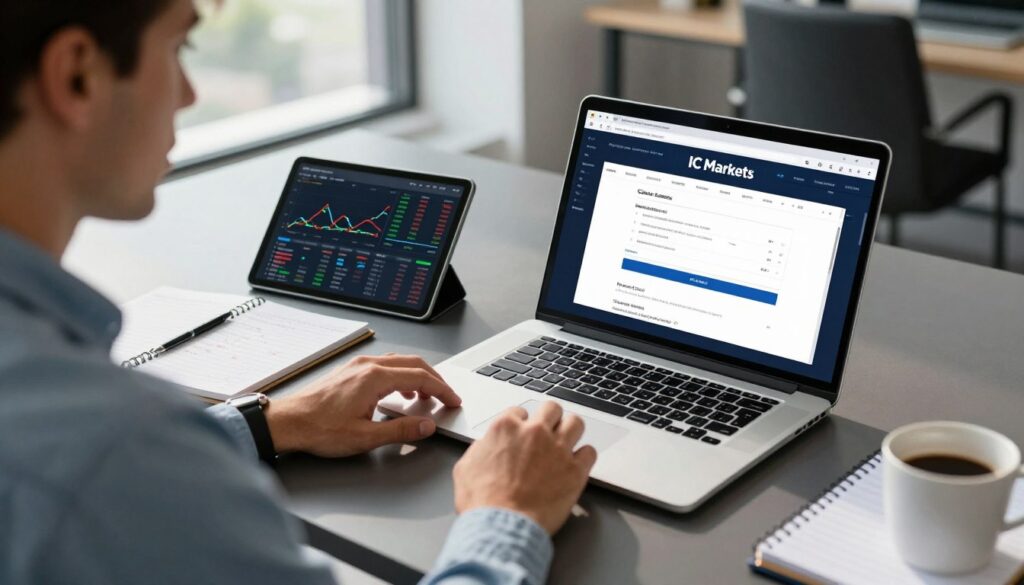
Opening a trading account with IC Markets is simple and user-friendly, catering to both beginners and experienced traders. To get started, users must complete an online application. This includes providing proof of identity, as mandated by the Anti-Money Laundering Act 2020.
Traders can choose between two account types: the Standard Account and the Raw Spread Account. The Standard Account is commission-free, while the Raw Spread Account incurs a commission of $7 per standard lot round turn. This flexibility allows traders to select an account that best fits their trading style.
To activate the account, a minimum deposit of USD 200 is required. Clients can fund their accounts in one of ten supported base currencies, such as USD, AUD, or EUR. This helps avoid unnecessary conversion fees and makes trading more efficient.
Once the registration process is complete, clients receive their login credentials for the secure Client Area and trading platforms. With 24/7 support available, traders can feel confident as they embark on their trading journey.
Choosing the Right Leverage Ratio for Your Trading Style

Choosing the correct leverage ratio is a critical step for traders to maximize their potential while managing risks. The ideal ratio depends on various factors, including individual risk tolerance and trading strategies. Understanding these elements can lead to more informed decisions.
Factors to Consider
When selecting a leverage ratio, traders should evaluate:
- Risk Tolerance: Know your comfort level with potential losses.
- Market Volatility: Consider how price fluctuations can impact your trades.
- Trading Style: Scalpers often prefer higher leverage to capitalize on small price movements.
Risk Tolerance Guidelines
Traders must assess their risk appetite carefully. Here are some guidelines:
- Evaluate the volatility of the currency pairs you wish to trade.
- Consider starting with lower leverage to build confidence.
- Utilize educational resources, such as webinars and blog posts, to enhance your understanding.
Understanding Margin and Required Deposits

Margin plays a vital role in trading, serving as the collateral needed to open and sustain positions. It allows traders to hold larger positions than their actual account balance. Understanding this concept is essential for successful trading.
IC Markets supports a wide range of funding methods, including:
- Bank Transfers: Reliable but may take longer.
- Credit Cards: Processed instantly for quick access.
- Skrill and Neteller: E-wallets that offer immediate deposits.
Online deposits are typically processed instantly, allowing traders to start trading without unnecessary delays. However, international bank transfers may take three to five working days to be credited to the trading account.
Moreover, there are no deposit fees for most methods, ensuring that clients can manage their capital efficiently and cost-effectively.
Managing Trading Risk with Leverage

In the trading world, understanding how to manage risk can significantly impact a trader’s success. Implementing effective strategies is essential to protect investments while utilizing leverage. One of the key methods is through stop-loss and take-profit orders.
Implementing Stop Loss and Take Profit Orders
Stop-loss and take-profit orders are executed at the best available market price. While these orders are vital for managing risk, it’s important to note that the firm does not guarantee execution. Traders should use these tools wisely to minimize potential losses.
Developing a Risk Management Strategy
A robust risk management strategy should include:
- Position Sizing: Calculate position sizes based on account equity to limit potential losses.
- Swap Rates: Be aware that triple swap rates are charged on Wednesdays for positions held overnight.
- Dividend Adjustments: Understand that dividend adjustments are applied to share and index CFD positions, affecting trade profitability.
- Market Volatility: Account for potential slippage during high-impact news events.
By developing a comprehensive risk management plan, traders can navigate the complexities of the market more effectively.
Tips for Safe and Effective Use of Leverage
To thrive in the trading environment, it’s essential to implement safe practices when using leverage. Here are some vital tips for traders:
- Never risk more than you can afford to lose: This is a primary rule for safe trading.
- Regularly review your trading plan: Adjust leverage based on performance and market conditions.
- Utilize demo accounts: Test strategies risk-free before committing real capital.
- Keep passwords secure: Change them if a security breach is suspected.
- Stay informed: Monitor market news that could impact your open positions.
By following these guidelines, traders can better manage their risks and make informed decisions in the dynamic trading world.
Exploring IC Markets’ Trading Platforms
IC Markets provides a robust suite of trading platforms designed to meet the diverse needs of traders. The firm offers three main platforms: MetaTrader 4, MetaTrader 5, and cTrader. Each platform is equipped with advanced charting tools and one-click execution capabilities, making it easier for users to navigate the trading world.
Platform Features and Tools
These platforms come with several features that enhance trading efficiency:
- Advanced Order Types: Traders can utilize limit, stop-limit, and one-click orders for precise control.
- Depth-of-Market Features: This allows traders to see liquidity at various price levels, crucial for making informed decisions.
- 24/7 Support: Users have access to continuous assistance, ensuring they can trade confidently.
Order Execution and Latency
IC Markets leverages the Equinix NY4 data center in New York to achieve low-latency execution. Average trade execution speeds are under 40 milliseconds, significantly reducing slippage for active traders. This infrastructure ensures that traders can capitalize on market movements effectively.
Navigating IC Markets’ Account Types
Understanding the various account types at IC Markets is essential for traders looking to optimize their trading experience. The firm offers two primary accounts, each designed to cater to different trading styles and needs.
Standard Account Benefits
The Standard Account is perfect for beginners. It offers zero commission trading with spreads starting from as low as 0.8 pips. This account type allows traders to enter the market without worrying about additional costs, making it a great choice for those just starting out.
Raw Spread Account Details
For more experienced traders, the Raw Spread Account provides institutional-grade pricing. It features spreads from 0.0 pips, but comes with a $7 commission per round turn. This account type is ideal for those who prefer tighter spreads and are comfortable with commission structures.
Both account types support micro lot trading, allowing for precise position sizing. Additionally, IC Markets provides 24/7 support via live chat, phone, and email to assist clients with any inquiries. Choosing the right account depends on whether traders prefer commission-free trading or the tightest possible spreads.
Leverage and Trading Conditions at IC Markets
Understanding the trading conditions at IC Markets is essential for effective trading. The firm offers trading hours that span 24 hours a day, five days a week. This allows traders to capitalize on global market trends at any time during the week.
The server time is set to GMT+2 or GMT+3, aligning daily candles with the 5 PM New York close. Specific trading hours for gold (XAUUSD) are from 01:02 to 23:57, while silver (XAGUSD) trades from 01:00 to 23:59 according to MetaTrader 4 Server Time.
IC Markets sources pricing from multiple Tier-1 liquidity providers. This ensures tighter spreads and better price stability, especially during volatile periods. Understanding market depth is crucial for traders, as it provides insight into the volume available at different price levels for various instruments.
- Trading hours for most products are 24 hours a day, allowing users to capitalize on global market trends throughout the week.
- The firm’s server time is set to GMT+2 or GMT+3 to align daily candles with the 5 PM New York close.
- Gold and silver have specific trading hours, with gold opening at 01:02 and silver at 01:00 MetaTrader 4 Server Time.
- By aggregating pricing from multiple Tier-1 liquidity providers, the firm ensures tighter spreads and better price stability during volatile periods.
- Understanding market depth is crucial for traders, as it provides insight into the volume available at different price levels for various instruments.
Using Leverage to Grow Your Trading Portfolio
Traders can harness the power of leverage to expand their trading portfolios across a vast array of financial products. This approach allows for diversification across over 1980 products, including Forex, stocks, and commodities, with limited capital. As account equity grows, traders can scale their positions, using leverage to increase their exposure to profitable market trends.
The firm offers social trading products, enabling users to copy the strategies of successful traders. This unique feature provides an opportunity for traders to grow their portfolios effectively. However, a disciplined approach to risk management is essential to ensure that portfolio growth remains sustainable over the long term.
Diversifying across different asset classes helps to spread risk, ensuring that the portfolio is not overly reliant on a single market. By taking advantage of various trading conditions, traders can enhance their overall performance and capitalize on emerging opportunities.
Understanding Regulatory and Security Measures at IC Markets
The safety of client funds and adherence to regulations are critical aspects of a trustworthy trading platform. IC Markets prioritizes client protection through various measures that ensure a secure trading environment.
Client Fund Protection
Client funds are held in segregated accounts with top-rated international banks. This separation ensures that client funds remain distinct from the firm’s capital, enhancing security.
Compliance and Global Regulations
Regulated by the Financial Services Authority of Seychelles (FSA), IC Markets adheres to strict compliance standards. This regulation protects its global client base, fostering trust and reliability.
- Client funds are kept in segregated accounts to ensure they remain separate from the firm’s own capital.
- Mandatory identification checks are performed to comply with anti-money laundering regulations.
- Personal information is handled with care and is not sold to third parties for marketing purposes.
- In case of a suspected security breach, clients are advised to change their passwords and contact support.
- 24/7 support is available to assist clients with any concerns regarding their accounts.
Strategies to Start Trading with Leverage Safely
Starting a trading journey requires careful planning and a clear strategy. Developing a comprehensive trading plan is essential for navigating the complexities of the market. This plan should define entry, exit, and risk management rules for every trade.
Developing a Comprehensive Trading Plan
A well-structured trading plan ensures consistency in decision-making. It helps traders remain disciplined and focused, especially during volatile market conditions. Here are key components to include:
- Entry and Exit Points: Clearly define when to enter and exit trades based on your analysis.
- Risk Management: Set limits on how much capital you are willing to risk on each trade.
- Market Analysis: Regularly review market conditions to adapt your strategy as needed.
Demo Accounts vs Live Trading
Demo accounts are excellent tools for familiarizing yourself with the trading platform and testing strategies without risking real capital. However, live trading environments may differ due to real-time market liquidity and volatility.
The firm offers educational webinars that help traders refine their skills and develop more effective strategies for using leverage. Maintaining consistency in following a well-defined trading plan is the most effective way to manage risk and achieve long-term success.
Final Reflections on Leveraging Opportunities
Maximizing returns in trading requires a thoughtful approach to leveraging available opportunities. By utilizing the firm’s institutional-grade infrastructure, traders can execute their strategies with confidence.
Success in this field demands a disciplined approach, including the consistent use of stop-loss orders and careful margin management. With 24/7 support and a variety of account types, every client has the tools necessary to navigate the financial markets.
Ultimately, responsible use of leverage, combined with continuous education, is the key to achieving sustainable growth in your trading journey. Whether you opt for a standard account or a raw spread account, the opportunities are vast.